Wardrobe Edit – Poshmark Update

It has been three months since I started selling items on Poshmark. Here are the results so far:

  • Items listed: 13
  • Number of items sold: 5
  • Total earned: $79.98

Being able to rehome some of my clothes, while making a few dollars has been great. So far I don’t miss any of the items! And I have been inspired to sell more items. With the earnings, I plan on buying a pair of leather boots, which will be thrifted.

In the search for those boots, I have been browsing my local consignment and secondhand stores. While shopping I have purchased three items, two of which I needed and one I am attempting to resell on Poshmark.The total of those three items was $19.81. It is fun to hunt through clothes looking for items that have resale value, but I am going to need to be careful that I don’t spend more than what I have already made selling on Poshmark.

Wardrobe net spending: $79.98 – $19.81 = $60.17.

Overview of my yearlong Wardrobe Edit Rules.

Bullet Journal – 10 things I removed and why

The Bullet Journal system has five kinds of layouts or collections: an Index, the Future Log, Monthly Logs, Daily Logs, and Custom Collections. Through trial and error, I discovered there is a good reason to keep your bullet journal simple.

If you look at social media for inspiration, you’ll find many beautiful spreads. I used many of these as templates in creating my own layouts. But making beautiful layout became too time-consuming. Other collection pages I added to my bullet journal but then realized they didn’t add value. This is a list of a few things I have stopped including in my bullet journal and why.

1. A Key

I have been bullet journaling long enough that I know my own system and don’t need to use the bullet key for reference. So I skip this page and save the pages at the beginning of my bullet journal for more useful information.

2. Complicated monthly themes

There is something exciting about planning a theme for an entire month. Thinking about all the little drawings and borders to include on each page for the month can be fun. But coming up with a new theme every month for years got old. And adding the month theme details to each page was too much work! Now the closest thing to a monthly theme is a different highlight color. The different colors are purely practical so that I can easily identify months when flipping through my bullet journal.

3. A Collection of Show and Movies I have watched

I thought that it would be a good idea to know what I have watched so I don’t watch it again. But Netflix already keeps a list of what I watch. Making a duplicate list didn’t prove to be beneficial.

4. Fancy Reading list Collection

In my first couple of bullet journals, I drew a picture of a bookcase with books on it and the title of what I read on those books. I also had a complicated color-coded method of marking when those books were read. Now I keep my reading list is a literal list format, and I read so much more!

5. Reflection/Brain dump pages

Longer writing can be done much faster in an electronic format. So instead of having unorganized blocks of text throughout my bullet journal, I keep all my reflections and more traditional journaling outside of my bullet journal.

6. Monthly Habit Trackers

These never worked for me. There always seemed to be too much flipping back and forth between pages. When I use my bullet journal on a daily basis, I look at that day’s log. I don’t always look at the monthly log. Tracking information on the monthly log just didn’t work for me.

7. Budget information

Monthly budget information is hard to record in a format that makes sense in a bullet journal. Keeping totals of spending categories requires math and a calculator. Budget information is much easier to track on a spreadsheet or an app specifically designed for budgeting.

8. Artwork

When I started my bullet journal, one of my goals was to have a place to keep all of my artwork. I really wanted to draw more and I thought that a bullet journal would help me to be more creative. Initially, it did. But as the mediums I used for artwork expanded, I couldn’t keep it in a bullet journal format.

9. Recipes

I love baking. Often I would jot down a recipe in my bullet journal. But once a bullet journal retires, I don’t like pulling it out again to reference the recipe. Now I keep all my recipes in their own notebook.

10. Difference Weekly Log layouts

I tried out so many different weekly log layouts. But once I found one that worked well, I don’t change it. In my current bullet journal, I use the same layout every week and it’s been helpful. Now when I flip through the journal looking for something, it is very easy to distinguish between different types of pages.

I hope these tips help you make your Bullet Journal work for your life. Happy journaling!

10 Most Recommended Nonfiction Books

Looking for your next inspiring read? These 10 books impacted the way I think about success and life. Many have been read more than once!

1. Grit: The Power of Passion and Perseverance by Angela Duckworth

Explains why we should do hard things and why it is good to embrace challenges rather than fear them.

I read this book after a career change and six months into my first software developer gig. Half a year was plenty of time to realize that I hated software development. Doing hard things is important, but you should also know when to quit. Grit talks about sticking to the difficult thing until the natural ending point. This helps increase your grittiness, but doesn’t prolong your misery longer than necessary. I decided to give that job a year, for the experience, and then looked for something that better suited my personality.

2. Your Brain at Work: Strategies for Overcoming Distraction, Regaining Focus, and Working Smarter All Day Long by David Rock

An in-depth look at how the brain sorts, prioritizes, organizes, and acts on information. Shows why certain tasks, like prioritizing and switching between tasks, can be so draining. Also, gives practical tips on how to make our brains work smarter.

Learning about sections of the brain like the basal ganglia and prefrontal cortex, was enlightening. Now I know why my brain does certain things! Super cool read if you find the brain fascinating.

3. The Life-Changing Magic of Tidying Up: The Japanese Art of Decluttering and Organizing by Marie Kondo

The basic premise – get rid of everything that doesn’t spark joy. Outlines how to deal with your material belongings and keep only the items that matter.

If you feel stuck, reading this and putting into practice its recommendations, can help you get unstuck. Helped me clear my mind and redefine my goals

Tip: Read this book before you move. If you do, you will own less, and moving will be much easier.

4. Essentialism: The Disciplined Pursuit of Less by Greg McKeown

How to filter out the nonessential, and focus on what truly matters.

This was one of the books that made me think about changing careers when I worked in accounting.

Favorite quote:

“If you don’t prioritize your life, someone else will.”

5. The Obstacle is the Way – by Ryan Holiday

Pulling from the philosophy of stoicism, this book explores the idea that the obstacles we face shape us. Therefore, those obstacles should be embraced as opportunities for growth.

As someone who doesn’t like change, but thrives on routine and security, The Obstacle is the Way challenged how I perceive challenges.

6. Burnout: The Secret to Unlocking the Stress Cycle by Emily Nagoski and Amelia Nagoski

A great book on emotional burnout. Geared specifically towards women and how their burnout is unique. Looks at stress and how people get stuck because they can’t complete the stress cycle.

Two big takeaways from this book were: the importance of exercise and sleep to reduce stress and the idea of human beings versus human givers.

7. The 4-Hour Workweek: Escape 9-5, Live Anywhere, and Join the New Rich by Timothy Ferriss

The book that launched many digital nomad dreams. At its core, this book is about lifestyle design and how to work more efficiently.

Reading this book made me realize that there was another way to live and that I should dream bigger. This was the second book that prompted a career change in my thirties.

8. Atomic Habits: An Easy & Proven Way to Build Good Habits & Break Bad Ones by James Clear

A book about small, but important habits. It outlines how to create good habits, using methods like habit stacking. This book is a fantastic audiobook, which is read by the author and begins with a gripping story of the author’s own life.

I have read many books on habits, and this one is my favorite! Very practical and inspiring. I like to read it every couple of years, or whenever I need to change my habits.

9. Rising Strong: The Reckoning. The Rumble. The Revolution by Brene Brown

We are all going to fall or fail. That is a given. This book is about what happens after that fall.

One summer I cried multiple times every week. After a really difficult year, which ended in disappointment, this book helped me get back up again. It was instrumental in learning to dream again.

10. Word by Word: a daily spiritual practice by Marilyn McEntyre

A book of meditations on individual words. Broken into weekly sections. Sometimes I need a whole week to think about what it means to “listen”, or “dare”. This book is inspiring and comforting, and after many reads, has become like an old friend.

10 Unexpected Benefits of a Bullet Journal

When I started my bullet journal in 2016, I had two goals:  a centralized place to store my drawings and to create some self-imposed structure for learning web development. But those goals morphed quickly. Just as I have changed through the years, the reasons I keep a bullet journal have changed too.

A lot has happened in the last four years, and keeping a bullet journal has resulted in some unexpected benefits.

1. Thankfulness

Every year I create a “things I want to do” list. I was looking through my first bullet journal recently and realized that I have actually done 4 things on my 2016 bucket list! Those four items didn’t get transferred into more recent journals and I had forgotten about them. But the realization that there were four things I was working towards in 2016 that I am either currently doing or have done in the last four years made me incredibly thankful for the life that I get to live.

2. A documented personal history

Writing down information about your days and weeks creates an incredible record of your life. I tend to forget past events easily. But whenever I flip through one of my old bullet journals, memories come rolling back. When an important event occurred is easily remembered because everything was recorded when it happened.

5. Insights on what makes you happy

Do you have a 5-year plan? I did. I was going to be a self-taught web-developer digital nomad who traveled the world. It was going to be so exciting! After reading “The 4-Hour Work Week: Escape the 9-5, Live Anywhere and join the New Rich” by Timothy Ferriss, and following blogs by people who were successfully digital nomads, I decided that it was the life for me. If other people were successfully traveling and working, I figured I could too.

But just because someone else thrives in a trendy lifestyle, doesn’t mean its right for you. Fortunately, I found this out early in my 5-year plan. After multiple trips that left me mentally and emotionally exhausted, I realized that solo longterm travel was not for me. For someone with my personality type, routine and stability are necessary for happiness.

4. Mindfulness

Keeping a bullet journal makes me pay attention to my days, weeks, and years. At the beginning of each week, I always create a new weekly spread. This makes me really think about what is happening that week, taking note of how I feel, what I need to do, the places I need to go. Every day, I write down what is important for that day. Focusing on one day at a time has made me more conscientious about how I live out my days. There is a quote by Annie Dillard that I love and beautifully illustrates the importance of how we structure our days.

“How we spend our days is, of course, how we spend our lives. What we do with this hour, and that one, is what we are doing. A schedule defends from chaos and whim. It is a net for catching days. It is a scaffolding on which a worker can stand and labor with both hands at sections of time. A schedule is a mock-up of reason and order—willed, faked, and so brought into being; it is a peace and a haven set into the wreck of time; it is a lifeboat on which you find yourself, decades later, still living.” – Annie Dillard, The Writing Life

5. Peace of mind

I don’t have to worry about forgetting important events. Everything is recorded in the bullet journal. By taking the time to plan each month, I know exactly what events are coming up. Nothing that can be schedule takes me by surprise anymore. All my bills are paid on time, birthdays don’t sneak up on me, and I don’t have that nagging feeling that I am forgetting something important.

6. More productive

Productivity should be a given when it comes to keeping a bullet journal but wasn’t my goal when I started. I love making lists and getting that dopamine release when I cross off an item. But before using a bullet journal, I lost most to-do lists before finishing them. Keeping all of my to-do lists in a single place, organized by month, week, and day helps me get way more done.

7. Goal Tracking

I like to have a list of micro-goals, smalls things like daily habits, and macro-goals that are perhaps a bit more lifechanging. Keeping track of my goals has been insightful because it has shown me what I actually find valuable. This, in turn, has lead to more impactful goals.

8. It’s a great traveling companion

On trips, I always take my bullet journal. Before the trip, I also use it to create packing lists and keep my travel itinerary. While waiting in airports or taking a break at a coffee shop, I love to write down notes about my experiences. Sometimes I will illustrate some of my favorite things about the trip. Writing down even a line or two about the trip helps me remember it more clearly in the future.

9. Better Health

A bullet journal is a great way to track health issues. I have quite a few food allergies. While working with a doctor, I was able to use my bullet journal to track food intake and symptoms. By keeping a meticulous health log for a year, I was able to improve both my physical and emotional health.

10. Helps prevent boredom

In my bullet journal, I keep a list of things that I think are fun or know I enjoy. Things like books I want to read, local places I have never visited, and sewing projects I would like to do. Whenever I find I need something to do, a quick look at my journal gives me plenty of inspiration. If that fails, I can always take those quiet moments to add to my bullet journal and create something beautiful.

Happy bullet journaling folks!

10 Tips for starting a Bullet Journal

I have kept a bullet journal since 2016, use it every day to schedule and organize my life. Recently I pulled out my very first journal, what a walk down memory land! A bullet journal is one of my most important daily habits and I highly encourage keeping one. Before you start a bullet journal, here are 10 tips to consider.

    1. Read the original Bullet Journal website. – It will simplify the process and outline why the bullet journal system works.
    2. Define your goals. – Why do you want to keep a bullet journal? I started mine to keep myself more organized and to have a central location to keep lists and quotes. The goals of my bullet journal practice have changed and evolved over the years, depending on the season of life I was in.
    3. Don’t start at the beginning of the year. – It can be really tempting to only start a bullet journal at the beginning of the year. Creating a beautiful beginning of the year spread can be so exciting. I love the New Year because I get to organize a new year and dream of all the things that might happen! But starting in the middle of the year lets you try out different methods to figure out what works for you.
    4. Use what you already have. – When you start your first bullet journal, start with a notebook you already have. No need to go buy specialized items for a habit that might not stick. Use an old notebook and a pen that you like to get into the habit first. My first bullet journal started halfway through a drawing notebook.
    5. Use the same kind of pens. – To keep your bullet journal neat and more uniform, use the same kind of pen and markers if using color.
    6. Keep a pen test page. – In the back of your bullet journal, make a pen test page. Keep track of the pens you have and what they look like on the page. This helps prevent the purchase of duplicate markers and ensures that the pen you use doesn’t bleed through the page.
    7. Use a notebook with numbered pages. – This way it is possible to keep an index of your pages and makes it easy to find pages in the future. I reference my bullet journals from past years frequently and this makes it so easy to find what I am looking for.
    8. Don’t strive for perfection. – If you want the perfect bullet journal, you won’t keep one for long. You are going to make mistakes. Every page won’t be beautiful. Some pages you think you will find useful, won’t ever be referenced again. And that’s okay. A bullet journal is supposed to add value to your life, so make it useful and not perfect.
    9. Use social media inspiration sparingly. – There are so many examples of amazing bullet journal pages on YouTube, Instagram, and Pinterest. And I confess I have a whole Pinterest board dedicated to bullet journal inspiration. But trying to copy certain layouts takes so long! If you don’t have the time to spend several hours a week on your bullet journal, don’t try complicated layouts. These days I use the exact same layout for all my weekly spreads and it saves me so much time.
    10. Drop what isn’t useful. – If something isn’t useful to you, you don’t need to use it. Those elaborate habit trackers may seem like a great idea, if you only find you use them for half a month and then drop them, maybe you need to change your approach. After using a bullet journal for a few months, review what you use frequently, and make adjustments accordingly.

I hope these tips help you as you start your bullet journal. Have fun and happy journaling!

Current Bullet Journal Layout

My current bullet journal is the simplest one yet. Here is how it is organized and what information I keep and why.

Yearly Setup – kept at the front of the bullet journal

  1. Index page – essential for referencing all the lists interspersed through my daily spreads. At the beginning of the year, an index doesn’t seem important, but by July it saves me from flipping through pages trying to find things.
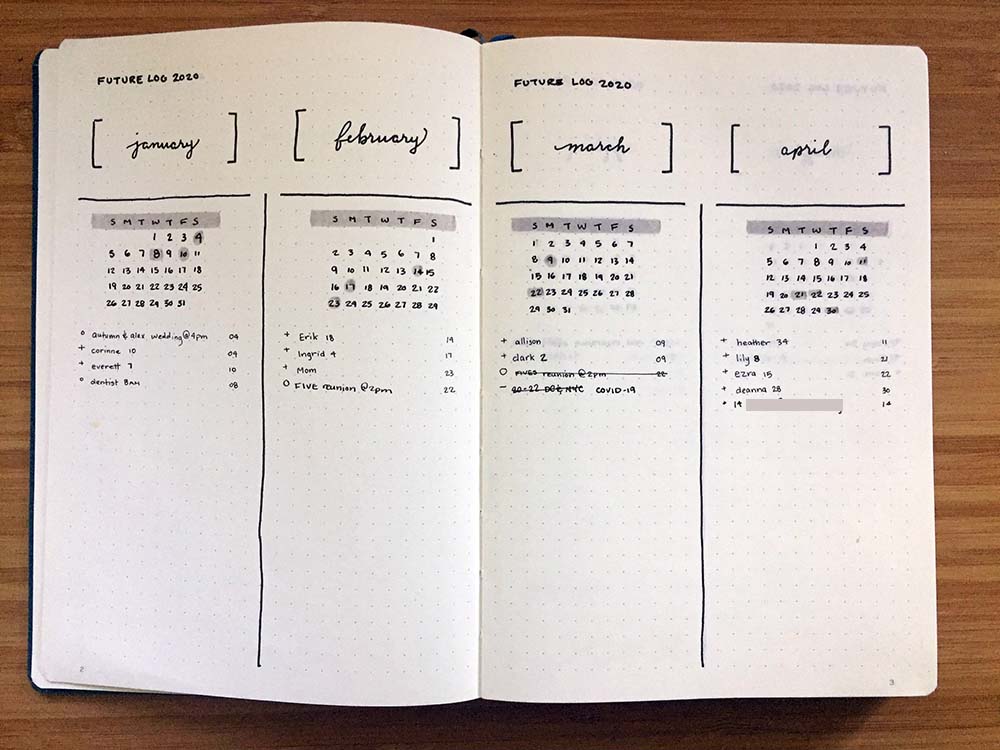
  2. A future log – this is where I keep track of important dates like birthdays, vacation days, travel, and appointments. Its rare that past months are referenced, but when I start each month I copy over the events for the current month onto my monthly spread. To allow plenty of space for notes, the future log is split into three double pages.
  3. Goals for the Year – one page for a list of goals I would like to accomplish in the year and one for goals for each month. These goals don’t need to be lofty. One of my monthly goals is to file that month’s paperwork.
  4. Book List – a great and track the books I read and want to read. Books I want to read are indicated by an empty bullet point. Once the book is read, the bullet point is filled in and the date the book was finished is noted. No more wondering what my next read should be!Generic Lists
  5. Craft List – a list of things I intend to make one day. Empty bullet point list and once I make the craft – anything from felted Christmas ornaments to an apron – the bullet point gets filled in.
  6. Wardrobe changes – I want to be more intentional with my wardrobe purchases. Keeping track of what I purchase helps me reduce the mindless purchase of new clothes.
  7. When Did I Last… – A list of things that only happen a few times a year with their corresponding dates. Things like getting my oil changed, the date of my last flu shot, and when I last changed my toothbrush.
  8. Health Notes – a quick reference for information on allergies, appointments, and vaccinations.
  9. Things I Want/Need – List of purchase I need to plan for, essentially anything that I am not going to buy at the grocery. Also, a great place to list what I think I want and then reflect on before purchasing.
  10. Extra Income – a partial page to keep track of miscellaneous income from babysitting or selling unused items from my wardrobe on Poshmark.
  11. Dates – partial page to keep track of any dates I go on. Each date’s info is kept on a single line – the first name, where we went, initial impression, and the date.
  12. Weddings and Engagements – partial page to track when people get engaged and weddings for the year. A really easy way to keep track of people’s anniversaries years from now.
  13. PTO and sick days – a partial page where I like to track what days I took off from work, just incase in need it for reference.
  14. Important Events – a partial page to list the dates of important events – things like raises and moves. Especially useful for reference in future years.
  15. Baking Inspiration – whenever I come across anything that I think I would like to bake, I write it here so I don’t forget it when I have time to bake.
  16. Gift Ideas – I am a terrible gift-giver. Gift giving is not my love language! When I stumble across something that reminds me of someone, I take notes here in case I need a gift for them.
  17. One Day I Want To… – essentially a bucket list of things I want to do ‘one day’. Places I want to visit, and things I think would be cool to do.
  18. Job Thoughts – Personal notes on my job and my expectations. If I were planning on changing jobs, notes on that process would be kept on this page.
  19. Gym Classes – List of classes I attend at the gym and how frequently I attend them.
  20. Etsy Shop Ideas – I love the idea of multiple income sources, no matter how small. One idea for an income source was to sell digital downloads on Etsy. This page is where I keep all those ideas.

Monthly Spread

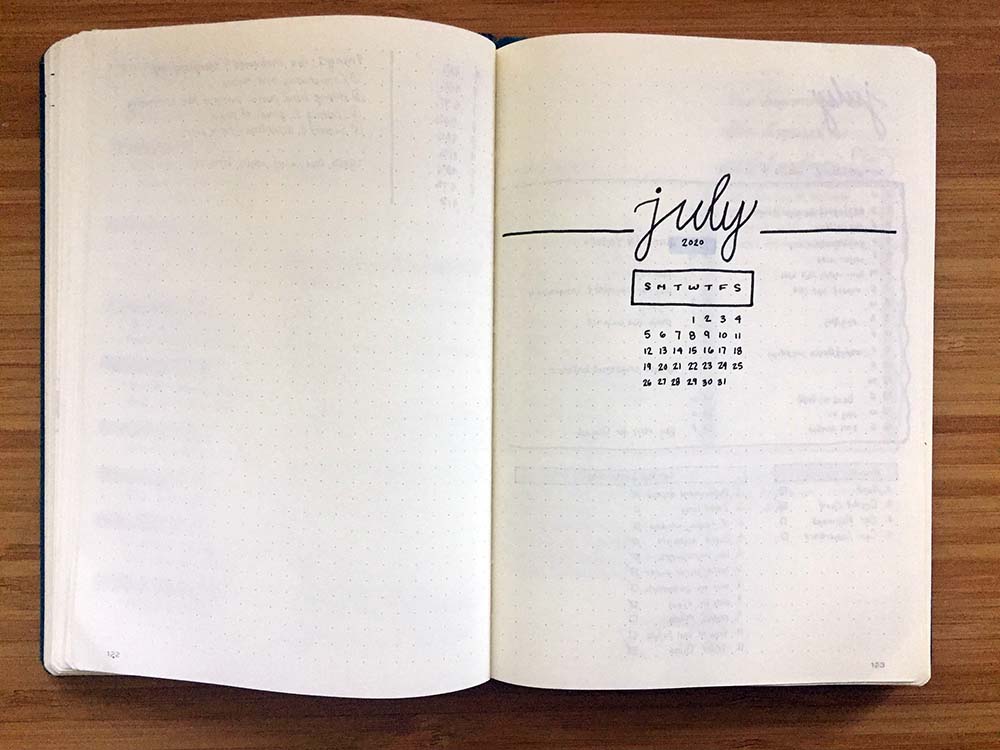
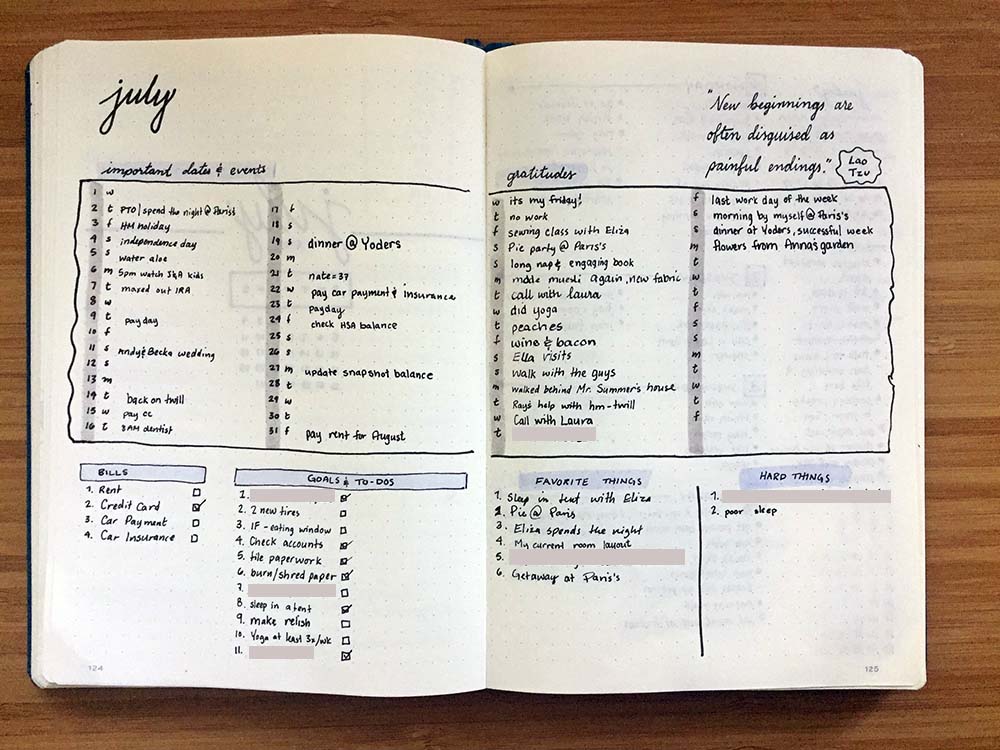
At the beginning of every month, I use two double pages to plan the month. Each month get its own unique color for accents and headers. This helps quickly identify each month when flipping through the pages. Every month has a combination of the following items.

Detailed monthly page

  1. Month Calendar for reference
  2. Goals specific for the month
  3. General To-Do list
  4. Favorite things that happened this month
  5. Bills I need to pay
  6. Gratitude List
  7. Days in a list format for keeping track of my schedule

Weekly Spread

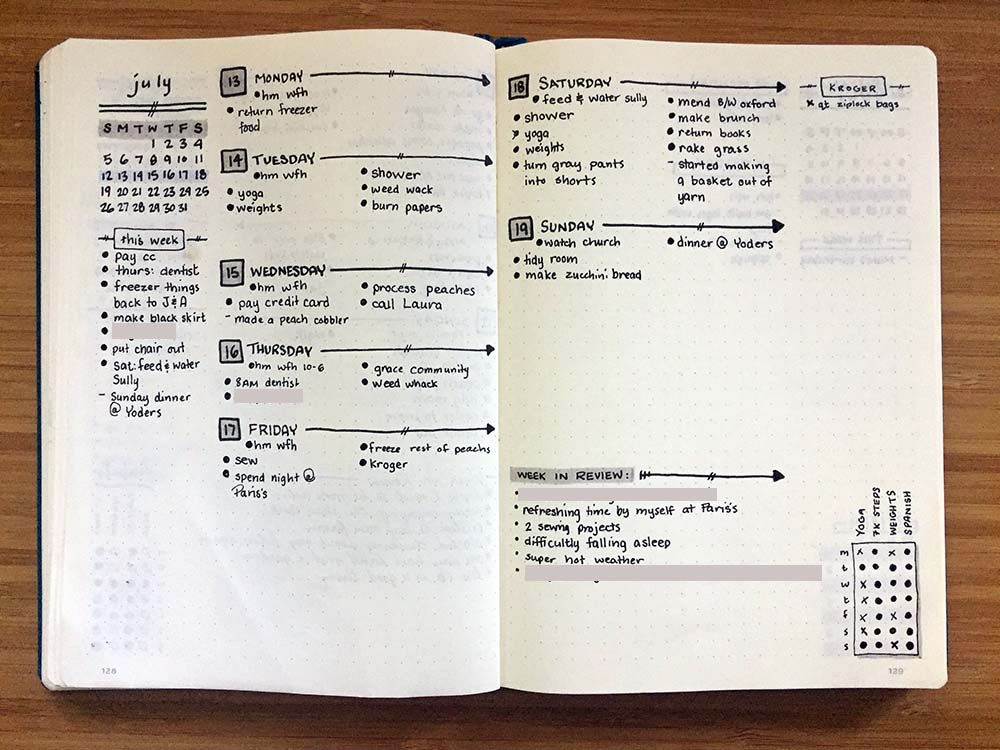
Every week takes up a one double-page spread. The weekly spreads are how I keep my life on track. Most of these pages now that the exact same format. These are very functional pages and rarely have any extensive doddles in the margins or fancy headings.

Weekly page

  1. The month in calendar format with current week highlighted – much easier to reference in the future this way.
  2. Days of the week in two columns in the center of the page – I only write out one day at a time with that day’s list. So the length of each day’s notes varies. I have found that I am more productive when I don’t try to plan out the entire week ahead of time.
  3. A weekly to-do list – everything I need to do for the week gets added to this list and then transferred to an individual day when needed. This may seem like extra work, but I find I am more likely to complete my to-do list this way.
  4. Habit tracker -I like to only focus on a few habits at a time. Some habits are more important during some weeks and I find this works better for me than a monthly or yearly tracker.
  5. Grocery list – list of what I need at the store. I never take my bullet journal into the store, what I do instead is take a picture of the grocery list with my phone.

Collections

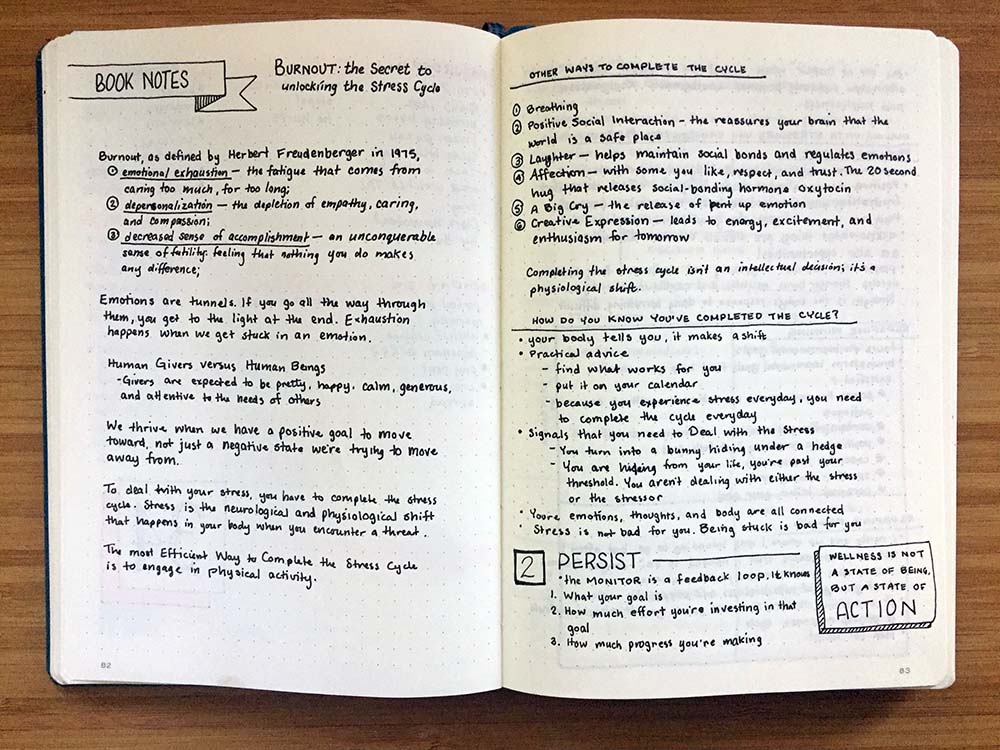
In a perfect world, all of my random notes throughout the year would be kept at the beginning of my bullet journal so that the month and weekly spread would be consistent. But I never know how many pages to reserve at the beginning of the year. My workaround is to put my collection pages between months. If there is something I want to turn into a collection page, I will count out how many pages I need for weekly spreads for the remainder of the month and then create the collection page. This ensures that there are no blank pages in my bullet journal.

Example Collection page

Collection Pages for this year so far…

  1. Quote pages
  2. Sketches of Herbs
  3. Book Notes: The Creative Habit by Twyla Tharp – still haven’t finished the book
  4. Book Notes: Recapturing the Wonder by Mike Cosper
  5. Book Notes: Burnout: the Secret to Unlock the Stress Cycle
  6. Birthday list – a few years ago I started making a list on my birthday of all the things I would like to do that year. This year it’s my 34 List.
  7. Garden plans
  8. Bedroom Organization Ideas
  9. Personality Test Notes – notes on my personality test results and the results of some of my friends
  10. On My Homestead – all my daydreams of what I would like to have on a hobby farm one day
  11. Blog Info – List of article ideas (including this one)

Beitou Park – A Green Getaway in Taipei

One of my favorite day trips within Taipei City was a visit to Beitou Park. The park is north of Taipei and close to Yangmingshan National Park. While researching the park, I didn’t have high expectations but was pleasantly surprised by this peaceful park.

Getting to Beitou Park 

It is easy to get to Beitou via the MRT. Accessibility is always one of my considerations when planning trips. In Taipei, I preferred riding the MRT over taking the bus because it is easier to navigate. To get to Beitou from Taipei Main Station, take the Red Line towards Tamsui. At the Beitou Station transfer to the Pink Line and ride to the end of the line which is the XinBeitou Station. The entrance to the park is across the street to the east.

Things to See and Do in Beitou Park

The park is a long, narrow strip of land with a creek running through the majority of it. If you start at the west entrance near the MRT station, you will find points of interest in this order.

Taipei Public Library, Beitou Branch 

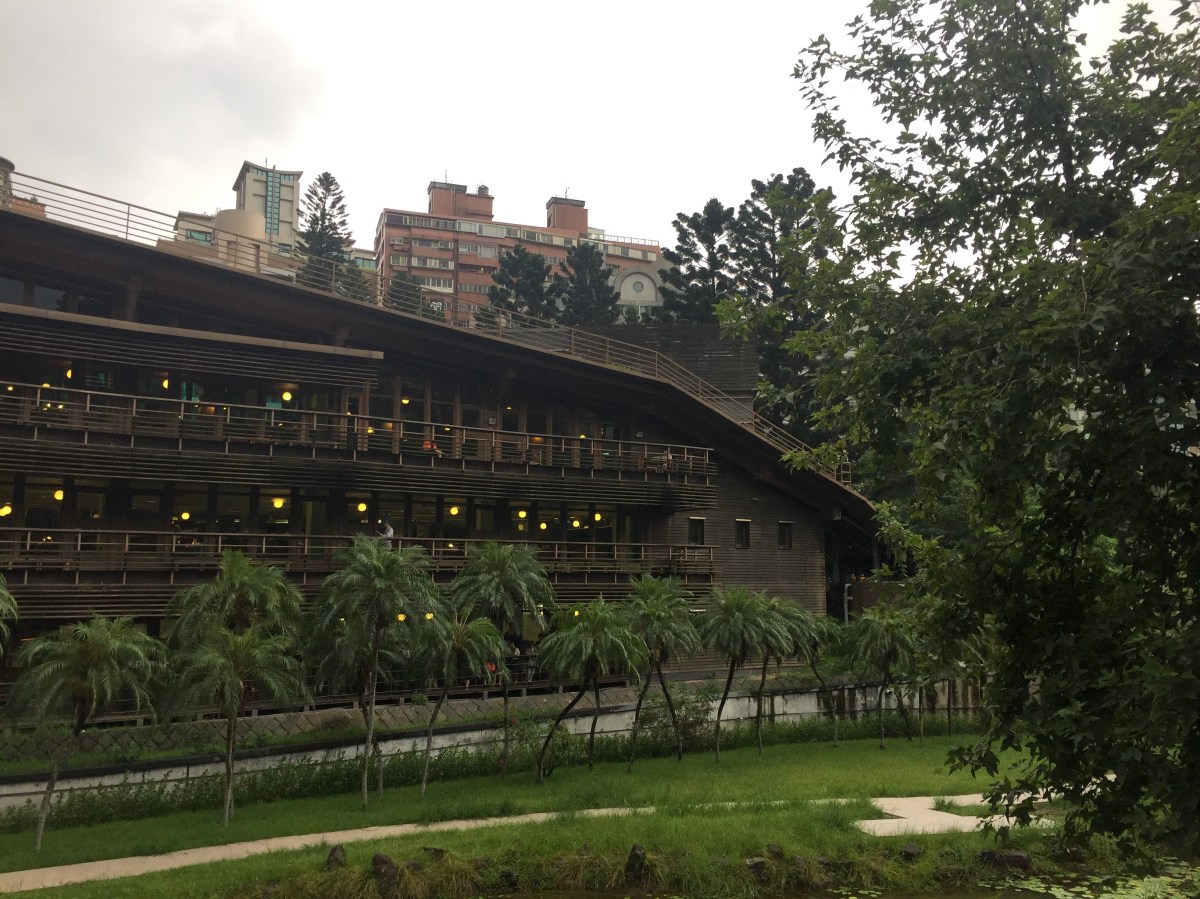
The library in the park is gorgeous. Three stories tall, with porches that overlook a waterlily pond, I wish I had found this gem earlier in my visit to Taipei.

It has a solemn friendliness. The interior is primarily warm wood with low bookcases that allow light from the windows to illuminate each floor. There are plenty of tables and armchairs for reading or studying. I even spotted books in English. It would be easy to spend hours tucked in a corner reading or journaling.

Beitou Hot Springs

Our next stop was the hot springs. We wanted to stop at the Beitou Hot Springs Museum, but it was closed for maintenance during September 2017. The public hot springs area was developed in the mid-nineties. There are private hot springs that are nicer if you want to pay the extra money. But if you really want to fully engage with the experience, the public hot springs are the way to go. The weather the day we were there was warm, as is usually during September, but was raining and made the hot springs still enjoyable.

Before entering the public hot springs area, you have to buy a pass from a vending machine at the entrance. There is a small shop to buy swimwear if you didn’t bring any or if what you bought doesn’t meet their criteria. Most women’s swimwear is acceptable. For men, there are a few more rules, one of which is no pockets. The lady at the turnstile into the pool area was friendly and spoke a little English. The six rock pools are on a three-level terrace, all enclosed with delightful plants and a fence for privacy. Unfortunately, photos are not allowed in the pool area, so it is hard to show exactly what it looks like. After taking a quick shower, and storing our belongings in the provided lockers, we surveyed the pools to pick out the best one for the initial dip. Most of the other bathers were elderly locals and other western tourists. Each pool had a sign indicating the temperature. On the top level of the terrace were the hottest pools, and to the side were two small pools with lower temps to help cool off after sitting in the hot pools. We picked a warm pool and after rinsing off our feet with the plastic pots sitting at the edge of the pool we entered the pool and enjoyed the warm, relaxing water.  

Thermal Pool

After enjoying the hot springs, we walked to the thermal pool, the source of the hot water flowing through the hot springs. This sulfur hot spring can reach boiling and emits stem even in the middle of summer.

Dinner at Sushi Express

After exploring the park and relaxing in the hot springs, we were starving. Fortunately, there is a Sushi Express across the street from the park near the MRT Station. I love Sushi Express. As someone with multiple food allergies, I appreciate the simplicity of sushi. It is easy to identify exactly what you are eating. And there is an unlimited supply of green tea. We wrapped up our day right when schools let out for the day and made our way home surrounded by chattering children in their school uniforms.

36 Hours in Hong Kong

I wish my visit to Hong Kong had been longer, 36 hours fly by quickly. In September 2017, I spent a month visiting a lifelong friend in Taipei. One of my goals while in Taiwan was to visit another country or large city. Hong Kong was close and the tickets were relatively cheap. So three of us decided to embark on a whirlwind tour.

We caught the last flight out of Taipei on a Thursday and arrived in Hong Kong just before midnight. There is a certain thrill to navigating a new city. Figuring out the currency and transportation system is like working out a giant puzzle. If you ever decide to fly to Hong Kong, I would suggest picking a flight with an earlier arrival time. The MTR Airport Express train which takes you all the way to the Central Station on Hong Kong Island stops running shortly after midnight. We had to take the double-decker night bus which stops at every imaginable stop. I tracked our location on my phone and watched as we made circles on the island where the Hong Kong International Airport is located. After at least 30 minutes, we finally made it off the island.

Our Airbnb was located in Tsim Sha Tsui, a few blocks off of Nathan Road. At 3am, we walked down our street which was littered with trash, and had people lurking in dark doorways, and suspected that we were staying in a sketchy neighborhood. Our host graciously had someone at the building to let us into our room in the middle of the night.

To best enjoy our time in Hong Kong, we slept until 9am and then started our day refreshed. Stop number one was caffeine. At home, I don’t frequent Starbucks, but on the road, I love the iconic brand. The closest Starbucks was a few blocks away and sipping on a hot black tea latte and people watching as they made their way to the MTR was the perfect start to the day. I think I even spotted two off duty models dressed in all black.

I had planned a rough itinerary for our day and we took the crowded MTR to Central Station. After gawking at the massive buildings in the financial district and watching people rush about in their well-cut business attire, we made our way to the Peak Tram. The Peak is on the highest mountain on Hong Kong Island and boasts numerous shops, restaurants, and walkways. It is a great spot to spend a few hours and get a fantastic view of Hong Kong and Victoria Harbour.

When traveling, I like to think about what I would do on my next visit. For there is so much information about a place that can only be gathered in person. And it is this first-hand experience that is the basis for planning the perfect excursion. Next time I visit Hong Kong and go to the Peak, I want to hike back down into the city. We walked down a section of trail and it was absolutely gorgeous.

It was a gently slopping paved walkway, lined with trees and a stunning vista of the city and harbor. The entire trail would have taken several hours and we had not budgeted the time in our schedule.

Instead of hiking back to the city, we caught a bus. I am glad we did. As we made our way down the mountain, we saw parts of the island that we would have otherwise missed. The ocean, a brilliant blue for as far as the key could see, lay to the south. Tucked between switchbacks, were skyscrapers impossibly perched on mountainsides. Gradually the mountain gave way to skyscrapers and we found ourselves back in the financial district.

One of the activities I enjoy while traveling is visiting parks. So we spent time in Hong Kong Park and Tamar Park on the banks of Victoria Harbor. The memory that is the clearest from our wanderings in Hong Kong Park is the fountain. It was shaped like a giant mushroom with a circular bench around the stem. There was room underneath the dome to stand without getting wet.

But where is the fun in that? I ran around the circumference of the fountain multiple times with my hand outstretched and running through the water. It was quite refreshing after the tropical heat.

On the way to Tamar Park, we got lost multiple times. On the map, it looked like it was only a few blocks away. Three blocks on surface-level streets are easy enough, but when you have to navigate multilevel underground malls, an MTR station, catwalks over busy roads, and sidewalks wrapped around governmental buildings, it gets confusing. But we finally made it to the harbor where we had a great view of Tsim Sha Tsui across the water, Hong Kong behind us, and boats ferrying people between the two places.

As evening approached we made our way back to Tsim Sha Tsui so that we could get a better view of the Hong Kong skyline as the sunset and the city became a dazzling display of lights.

On the way back to our Airbnb, we stopped for a Korean BBQ at a restaurant located on the 5th floor of a building that had a different restaurant on each floor. While looking for a place to eat, I was only looking at establishments on the ground floor. It didn’t occur to me to look up, even though there were giant signs on buildings advertising the restaurants located inside. Fortunately, my friend who lives in Taiwan knew how to spot the restaurants and found us a place before we expired from hunger.

After dinner, the Temple Street Night Market was in full swing on our street. This explained why the street was littered with trash at 3am the night of our arrival. The night market was different than the Taiwanese night markets I was accustomed to. There were more knockoff goods of brands that I actually recognized. I decided to purchase a pair of TOMS shoes and found a pair I liked. The lady had to run back to a store somewhere to get my size. But then I was the proud owner of a pair of navy, sized 42 TOMS, for the low price of $15 USD. The next day, on the way to the airport, the insoles of my new shoes kept on slipping around. Upon closer inspection, I noticed that there was a second pair of insoles in the shoes. When I took them out, it became evident that my size 42 shoes were actually 43. I had a good laugh and continued to walk through the airport in my too-big shoes.

Day Trip to Jiufen, Taiwan

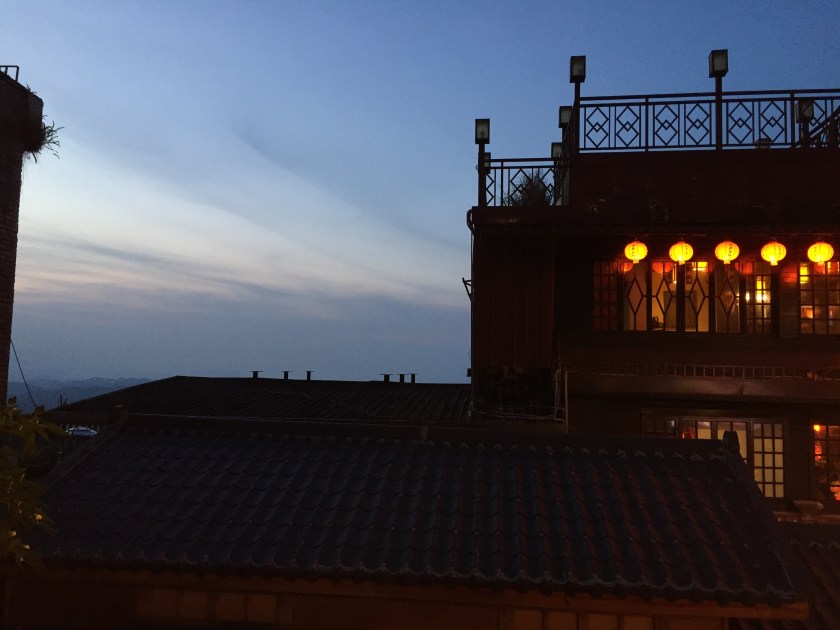
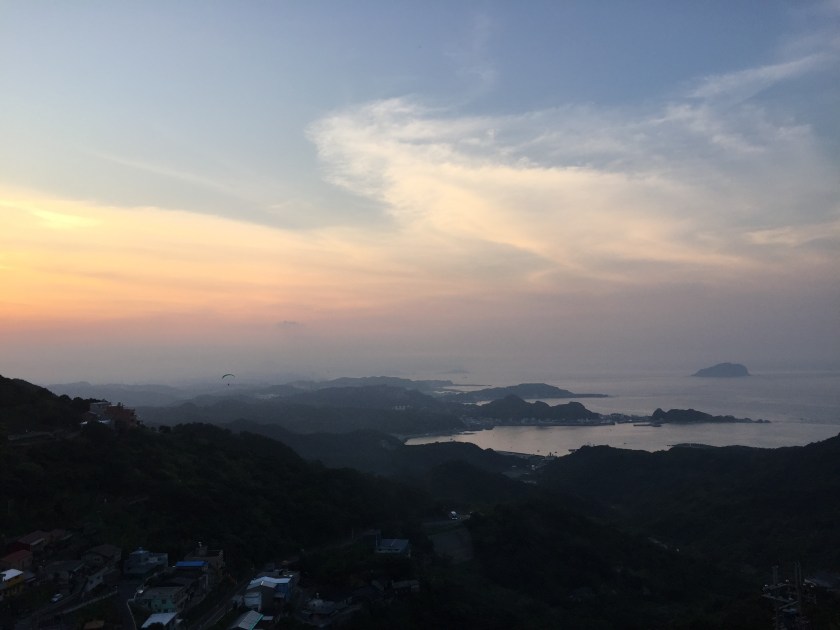
Jiufen is a Taiwanese village nestled in the mountains and overlooks the northern Pacific Ocean. The village boasts multiple Japanese style buildings and is often said to be the visual inspiration for the movie Spirited Away. While standing in the narrow streets, red paper lantern shining overhead, it is easy to imagine that you have been transported to a magical place.

IMG_3041

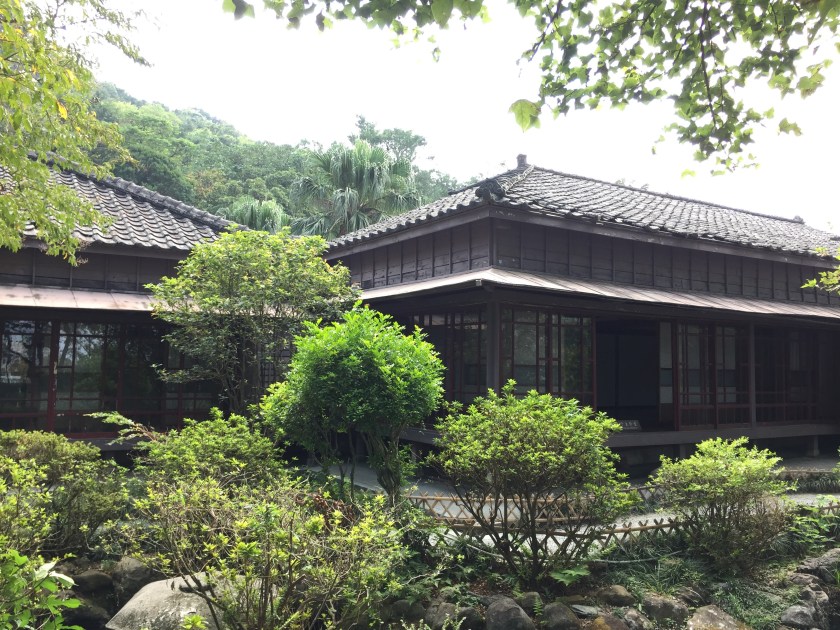
There is plenty to do in and around the village. Getting there from Taipei is easy. Using our Easycard, we took a bus from the Songshan station, the ride was only a few hours. The first stop was near the Gold Museum. Near the entrance of the Gold Museum are some historic Japanese style buildings. In the early twentieth century, a member of the royal family planned on visiting Taiwan, and the houses were built in preparation for their arrival. The buildings are quite lovely and I enjoyed walking around the grounds and seeing authentic Japanese architecture. If you spend time in Taiwan, you will notice that wood is rarely used as a building material. The Japanese buildings were built primarily with wood and I found it a refreshing change from the steel, concrete, and tile.

IMG_2914We decided to not visit the museum, as my attention span in museums is very short and I would rather spend time outdoors. Instead, we walked around the gardens and enjoyed the view of the village in the valley and the ocean in the distance. After we had our fill of the gardens we hopped on the bus for a short ride to Old Jiufen where the night market happens.
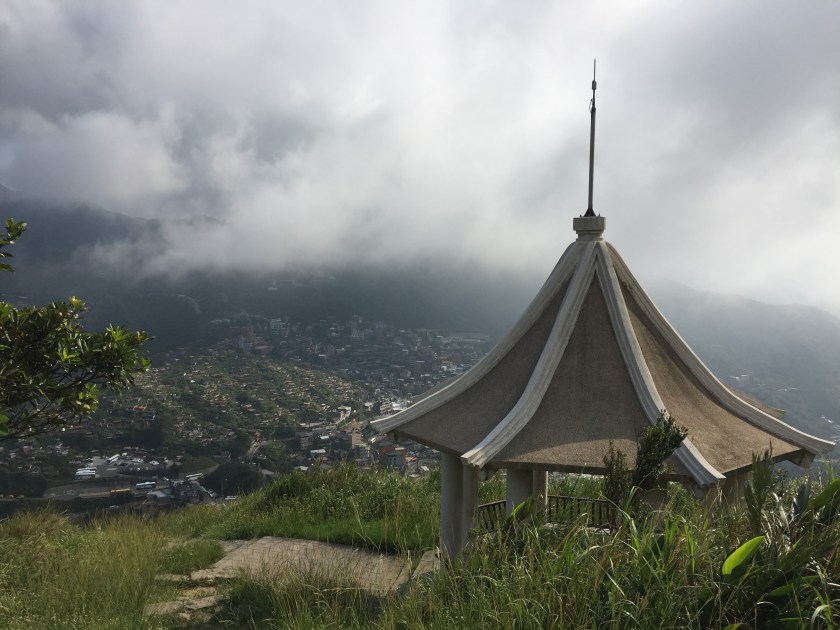
On the bus, we drove by Keelung Mountain and I noticed the entrance to a hiking trail just a few hundred yards from the bus stop. The trail didn’t look too difficult, and there were some adorable little gazebos interspersed along with it. The top of the mountain was sure to have fantastic views! However, trail composed completely of steps in 90-degree weather becomes difficult quickly. But we kept going and eventually made it to the top. At one point an elderly Taiwanese person with canes passed us going down the trail, there was no way we were going to give up after that.

By the time we made it to the top, clouds had rolled in and we were standing in the mild of one, completely obstructing the view. But as we rested, the wind carried it away and the village below could be seen. The panoramic view of the village, lush green mountains, and the ocean were definitely worth the wait. On the way down we passed a group of hikers having tea. One of the hikers had brought with them a teapot and a small stove. Tea and mountains are the perfect combinations. One day I want to copy them and drink hot tea in the middle of a hike.IMG_2952 Once back down in the village, we made our way to the night market. While walking through the crowded streets, we snacked on local street food. Sausage on a stick with cloves of fresh garlic, samples of mysterious dried fruit, and popsicles took the edge off our hunger. I love getting lost in villages with tiny stone streets, not knowing what will be around the next corner, and being surprised with public verandas with gorgeous views. After watching the sunset over the bay, we went in search of dinner.IMG_3009
One of my personal life philosophies is – always eat outside if it is an option. Dinner was a hodgepodge of meat, veggies, and rice. But it was delicious because it was eaten on a balcony on a mountainside. One lesson that I took away from the meal, is that overstepped lavender tea is not pleasant.

After dinner, we went in search of a teahouse with a rooftop tea room. We settled on the Jioufen Teahouse (Jiufen and Jioufen are interchangeable). At the teahouse, one is served tea and small sweet treats. In this case, there were dried plums, pressed green cakes with a sweet center,  brown sugar mochi, and various kinds of sesame candy. But the experience is really all about the tea. The server gave detailed instructions on how to properly experience the tea.

The setup included a gigantic kettle of hot water, which is kept warm by sitting on a small fire in an earthenware pot of the floor beside the table, a bamboo water box, small teapot to brew the tea, a second teapot to serve the tea, cups, and saucers, and a bowl of oolong tea.

Each pot of tea could be steeped five times and there was enough tea for 4 pots. I acted as the tea preparer and enjoyed the dance of timing each steep and keeping all three cups supplied with oolong. There was plenty of tea and we had our fill before the bowl of the loose leaf was empty. I tucked the extra in my backpack and brought it home at the end of the night.

IMG_3016